← All work
Personal project · open source · 2026
GreyMatter
Persistent memory for command-line agents: an installable engine, kept separate from your notes, that updates itself. Published as open source.
- Role
- Design, architecture, extraction, publication
- Python
- Bash
- Electron
- WebGL
- GitHub Actions
- Apache 2.0
- Result
- 46 releases published under Apache 2.0, installable in one command — and a leak check that is allowed to block any publication.
Stack
The capsule sits in a corner of the screen and asks for nothing. The line underneath names the task in hand. It is the engine’s only interface: everything else is text.
What it is for
A command-line agent is brilliant inside a session and amnesiac between two. GreyMatter gives it memory that lasts: whatever is solved once is distilled into a note, filed, linked, and resurfaces on its own in the next session.
What the engine does
- Distillation: a working session becomes clean notes — one fact per note, with its provenance and its degree of certainty.
- Automatic recall: on every question asked, the relevant notes come back on their own, with nothing to look up.
- Knowledge tree: notes link to each other; a lesson learned on one project is findable from every other.
- Gardening agents: eight specialised roles file, de-duplicate, challenge stale notes and repair broken links.
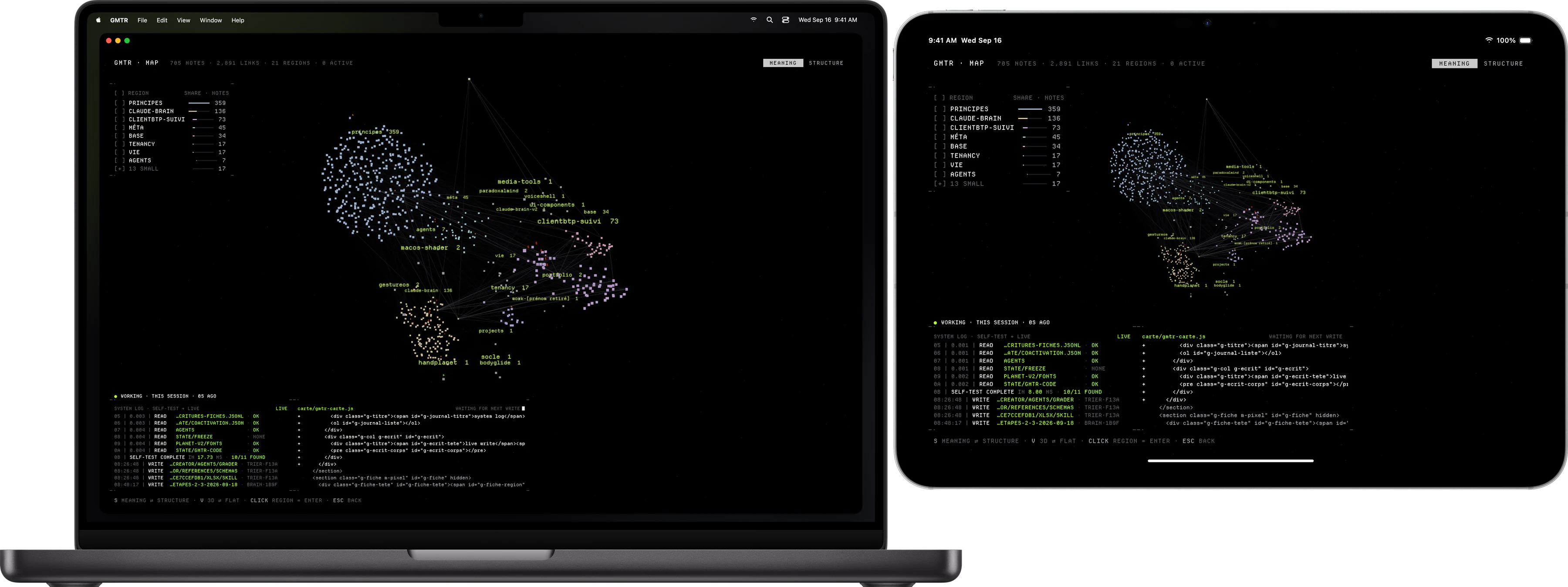
- 3D planet: the whole graph is visualised in real time, one continent per domain.
How a session becomes memory
Everything runs on the machine — nothing here is a service you log into
- 01 The trunk Plain Markdown files on the machine: the notes, the map, the state.
- 02 On every prompt A lexical search picks the few notes that answer, and pastes them into the question.
- 03 During the session What is written and what is read are recorded — the real material of the work.
- 04 At session end The session is archived, then the agents wake: two always, a third only if its sensor crosses a threshold.
What makes publication possible
Two folders that never mix
The engine — disposable, replaced on every update
- The code that files, links and retrieves
- The checks and the measurement benches
- The install and migration tooling
The trunk — it only moves when I write
- A year of notes, lessons and decisions
- Client names, addresses, machine paths
- What an update must never touch
The chain that protects the lived record
From the living notebook to the public package
- 01 The living notebook A year of real notes: clients, addresses, machine paths.
- 02 Allow-list copy What is not named does not leave.
- 03 De-identification Replayable rules strip names, numbers and paths.
- 04 Leak check 21 markers. One of them turning red blocks the publication.
- 05 The public package The engine, installable by anyone. Never the lived record.
How it installs and stays alive
- One command: the package installs as an extension to a command-line agent.
- Every release is replayed by continuous integration: full install, uninstall, and every past migration run twice — with the requirement that it has eaten no note.
- 46 releases published, under the Apache 2.0 licence, on a public repository.
Source code: github.com/Yuno15-bb/c-brain